




BIEST
Geisterfaust
or
What I am, you will be
…Thus something exists only through its delimitation from something else, be it semiotic, spatial, physical or ideal. Only the con-finement of a phenomenon, its focusing, its extraction, makes insight possible. With Geisterfaust, Silvio Scheller and Mirko Hinrichs present an experience of space that, through reduction and concentration, evokes breadth of vision.
The idea of a protective shell, from clothing – to cave – to hut, is as young as humankind itself and thus a need as old as stone. And wasn’t the bedsheet thrown over the kitchen table already the fantastic idea of cave, shelter, separation and a space of one’s own? But how exactly is this need defined? Is a shell protective simply because it surrounds and, as a boundary, creates an additional, constructed space between the environment and one’s own body? Indeed, is it perhaps the shell that first makes one’s own extension, the self, tangible?
In the age of fortified stone architecture, in a culture unthinkable without it, to think anew about nomadism and mobile shells may sound paradoxical; yet there seems to be a current discrepancy between potential and experienced reality that makes such questions urgent.
So perhaps the solid modern construct of the domestic shell, which usually far outlasts a human life and towers far above human scale, is no longer the model that adequately meets contemporary human needs. The worldwide flow of information, goods, knowledge and individuals in permanent motion stands in considerable discrepancy to the existing models and structures of settledness and permanence. The insight that the defining characteristic of economic, social and communicative networks is precisely their processuality, situativity and interactivity is gaining ground. Linguistically interesting: for here, too, there is once again the implication of something fixed, permanent and precisely not flowing, which seems to convey security. Yet we will no longer find security realised in the outside world. This insight still hurts and finds its counterpart in the fragmenting biographies of a generation that has still not decided whether it wants to see the dissolution of traditional social and economic structures as an opportunity or a loss. Whether it wants to muster the strength for constant change, or rather for the attempt to hold on to the constant.
The hoped-for stony solidity, however, is crumbling; it becomes decrepit, confines more than it proves itself aesthetically and functionally. The promise of shelter, separation and individuality through massive architectural statements no longer sounds like serene satisfaction. What remains is a confusing unrest and a mistrust of settling in, of the settled, of en-during, of accumulating.
But who wants revolution? We have known, and not only since Hardt and Negri, that the system, to put it lightly, must be “questioned” from within, since a critique that relies on a subject-object opposition cannot become a dissolving force because of its self-excluding position; so let us go inside: the fear of the transient is the fear of nature, indeed of being itself.
It is no coincidence that Hinrichs and Scheller found each other in this project; both are united by the idea of reduction, indeed of essence; it is the idea of a mobile cocoon; the possibility of a space for thought, externally determined and self-fulfilled.
A modular box system
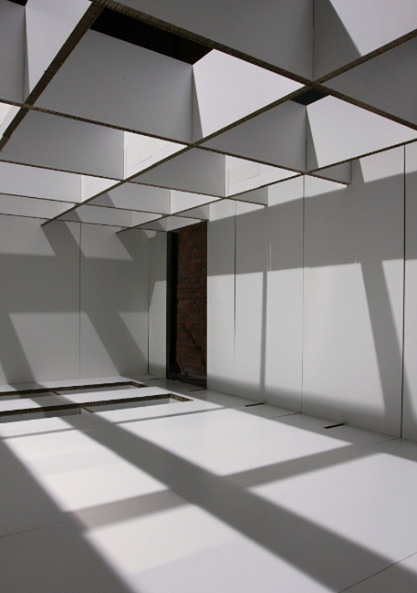
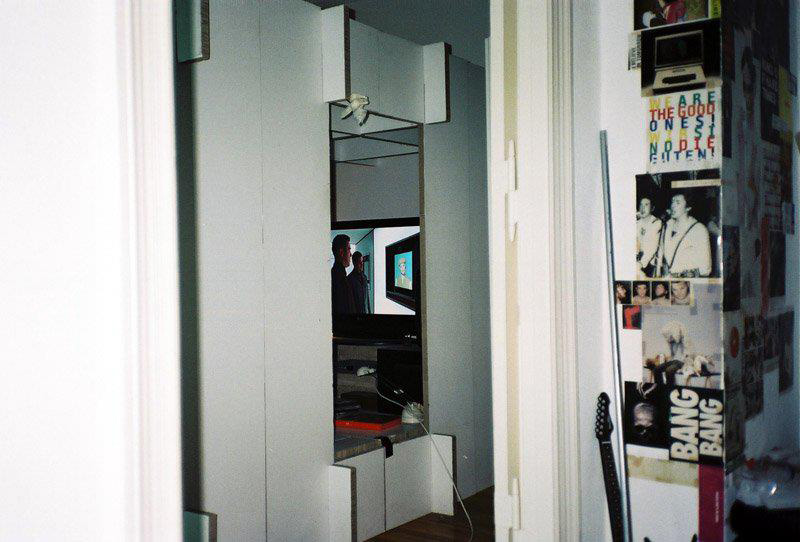
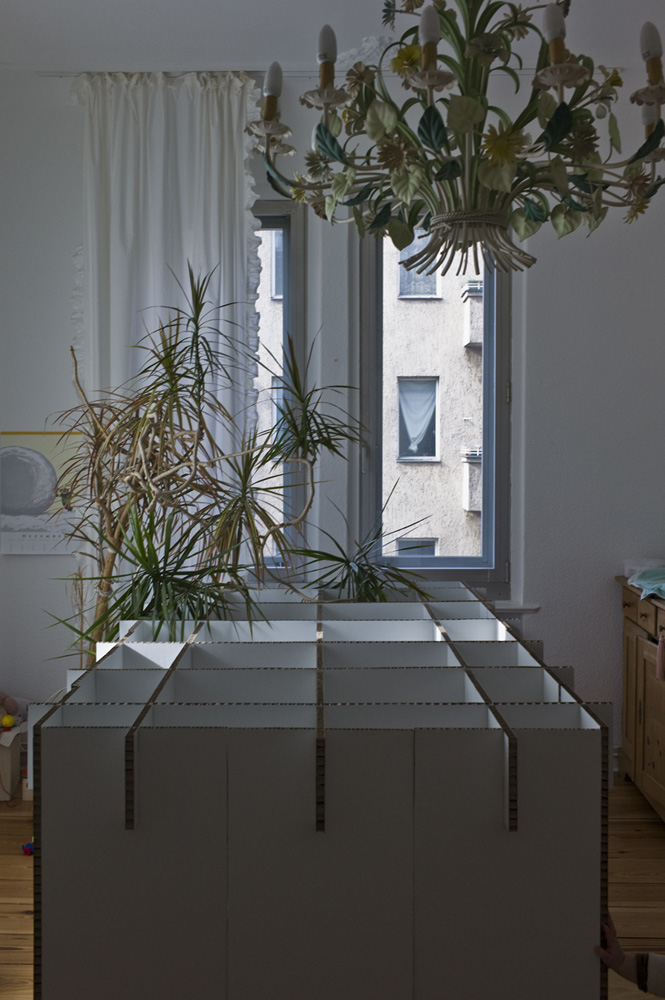
Hinrichs and Scheller present the minimal solution for a maximal, mobile space; their box can be installed anywhere within a very short time from prefabricated modules. With a variable floor plan there is almost no limitation: the box could fit in anywhere. Associations arise with positions such as Gordon Matta-Clark and Sol LeWitt, just as with the provisional and autonomous shack architectures born of necessity in the megacities of India or South America.
This shell wants to fit into something; yet to be a space in itself, one that can be placed flexibly, according to the situation, within a larger one. Implemented depending on context, it offers the potential to be a communicative space as well as a meditative cell, or else a functional place. Created from the remains of a former trade fair architecture, it is not only remarkably easy to set up and dismantle, but also fulfils demands for reusability and ecological responsibility.


Exhibition: Industriemuseum, Marianne Brandt Wettbewerb, Chemnitz, 2013

Exhibition: Berlin Design Selection, Design Miami Art Basel, 2013
Video: Miro Mastropasqua
Photo: Tobias Kruse/OSTKREUZ


